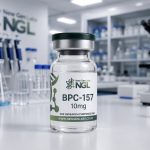
A peptide vial may contain only a small amount of white powder, but that format reflects a deliberate stability decision. Why are peptides supplied lyophilized rather than as ready-to-use liquids? For many research compounds, removing water is one of the most effective ways to limit degradation during storage and transit while giving researchers greater control over preparation conditions.
Lyophilization, also called freeze-drying, converts a peptide solution into a dry solid under carefully controlled conditions. The resulting powder is not automatically permanent or indestructible, but it is generally far more practical to store and ship than the same peptide in an aqueous solution. For laboratory-minded purchasers, understanding that distinction helps with evaluating product format, handling requirements, and documentation.
Why Are Peptides Supplied Lyophilized?
Peptides are chains of amino acids with structures that can be sensitive to their environment. In solution, water can enable or accelerate chemical pathways that gradually change the compound. Depending on the peptide, risks can include hydrolysis, oxidation, aggregation, deamidation, and loss of structural integrity. Temperature, light exposure, pH, dissolved oxygen, and repeated handling can all influence the rate of those changes.
Lyophilization addresses the water component of that problem. A manufacturer first freezes the peptide solution, then lowers pressure so frozen water can move directly from solid ice to vapor. This primary drying stage removes most of the water. A secondary drying stage removes more tightly bound residual moisture. What remains is a dry peptide cake or powder in a sealed vial.
The objective is not simply to make a product easier to package. It is to create a controlled solid-state format that can better preserve the material’s intended identity and quality profile across the supply chain. For research peptides, that can mean more reliable storage before reconstitution, provided the vial is handled according to its product-specific requirements.
Water Changes the Stability Equation
Water is essential for preparing many peptide solutions, but it can be a liability during long-term storage. When a peptide is dissolved, its molecules have greater mobility. That increased mobility can make certain degradation reactions more likely, particularly if storage conditions are unfavorable.
A lyophilized product has far less available water and reduced molecular movement. This can slow many degradation processes, although it does not eliminate them. Some peptides remain sensitive to oxygen, heat, light, or residual moisture even in dry form. That is why a quality lyophilized vial should still be kept sealed, protected from unsuitable conditions, and used within the applicable product specifications.
Stability also depends on the compound itself. A small, relatively simple peptide may tolerate storage conditions differently than a larger or more structurally complex molecule. Excipients, buffer components, vial headspace, stopper quality, and fill process can also affect the finished product. There is no single storage rule that applies identically to every research peptide.
Freeze-Drying Supports Shipping and Inventory Control
Liquid formulations are heavier, more vulnerable to leakage, and often more dependent on tightly maintained temperature controls. A dried vial is typically easier to package, transport, and store, especially when distribution involves multiple handling points.
For suppliers, lyophilization can support more consistent inventory management. For purchasers, it allows the researcher to keep the compound in its dry form until it is needed for a defined research workflow. This separation between storage and preparation is useful because an aqueous solution may have a substantially shorter acceptable use window than the unopened lyophilized material.
The trade-off is that freeze-dried products require correct reconstitution. The researcher must select an appropriate diluent for the intended laboratory application, use clean technique, and avoid assumptions about concentration. A vial labeled with a peptide mass does not become a working solution until a known volume of suitable diluent has been introduced and the material has fully dissolved.
Lyophilized Does Not Mean “No Handling Requirements”
A dry peptide is more convenient than a pre-mixed liquid in many cases, but it is not maintenance-free. Improper storage can compromise a lyophilized material before the vial is opened. Elevated temperatures, direct light, moisture intrusion, or a damaged closure can all affect quality.
The appearance of the powder can provide a basic handling check, but it is not a substitute for analytical verification. A typical lyophilized vial may contain a compact cake, flakes, or loose powder, depending on the formulation and process. Variation in appearance alone does not prove a product is unsuitable. However, obvious signs of moisture exposure, a compromised vial, missing identification, or unexplained discoloration should be treated as quality concerns requiring review rather than guesswork.
After reconstitution, the handling priorities change. The solution should be prepared only when required for the research protocol and stored according to the compound-specific guidance. Repeated warming and cooling, contamination, unsuitable pH, and unnecessary agitation can all introduce avoidable variability. Clear vial labeling with the preparation date, diluent, and calculated concentration is a basic but valuable laboratory control.
What Lyophilization Cannot Tell You
The presence of a lyophilized powder does not, by itself, establish peptide identity, purity, concentration, or suitability for a given research purpose. Freeze-drying is a formulation and preservation process. It is not a replacement for quality assurance.
That is why credible sourcing should extend beyond the physical format. Buyers should look for clear product identification, batch or lot traceability where available, appropriate storage information, and a certificate of analysis. A COA can help document the analytical testing associated with a batch, such as identity and purity methods or reported results. The specific tests and acceptance criteria matter, so the document should be reviewed rather than treated as a generic badge.
Third-party laboratory testing can add another layer of confidence when it is properly tied to the relevant batch and supported by transparent documentation. It is particularly useful in a market where visual inspection cannot distinguish a correctly manufactured peptide from an incorrectly labeled or degraded material.
Reconstitution Is Where Precision Returns
Lyophilization preserves flexibility, but it also places responsibility on the researcher at the point of preparation. The chosen diluent, final volume, target concentration, and storage period after reconstitution should be determined by the compound’s specifications and the research protocol.
Concentration calculations should be documented before preparation. If a vial contains a stated mass of peptide and a measured diluent volume is added, the resulting concentration follows directly from those two values. Recording that calculation reduces preventable labeling errors and makes future review easier.
Gentle handling is generally preferable to forceful shaking unless a validated procedure states otherwise. If material does not dissolve as expected, the correct response is not to improvise with unverified conditions. Review the product documentation, confirm the diluent and temperature requirements, and assess whether the material is appropriate for the intended research use.
A Format Built for Controlled Research Use
Lyophilized peptides are supplied in dry form because the format helps manage a central challenge in peptide research: preserving a sensitive compound from manufacture through storage, shipment, and eventual preparation. By reducing water activity, manufacturers can often improve practical stability and allow researchers to prepare solutions only when their workflow requires them.
The benefit is conditional, not absolute. Product quality still depends on trusted manufacturing, suitable packaging, verified testing, secure storage, and disciplined preparation. For research purchasers, the most useful question is not only whether a peptide is lyophilized, but whether its format, documentation, and handling requirements support a controlled and traceable research process.
A properly labeled, sealed lyophilized vial gives the researcher a stable starting point. The quality of the work that follows depends on maintaining that control at every stage.